
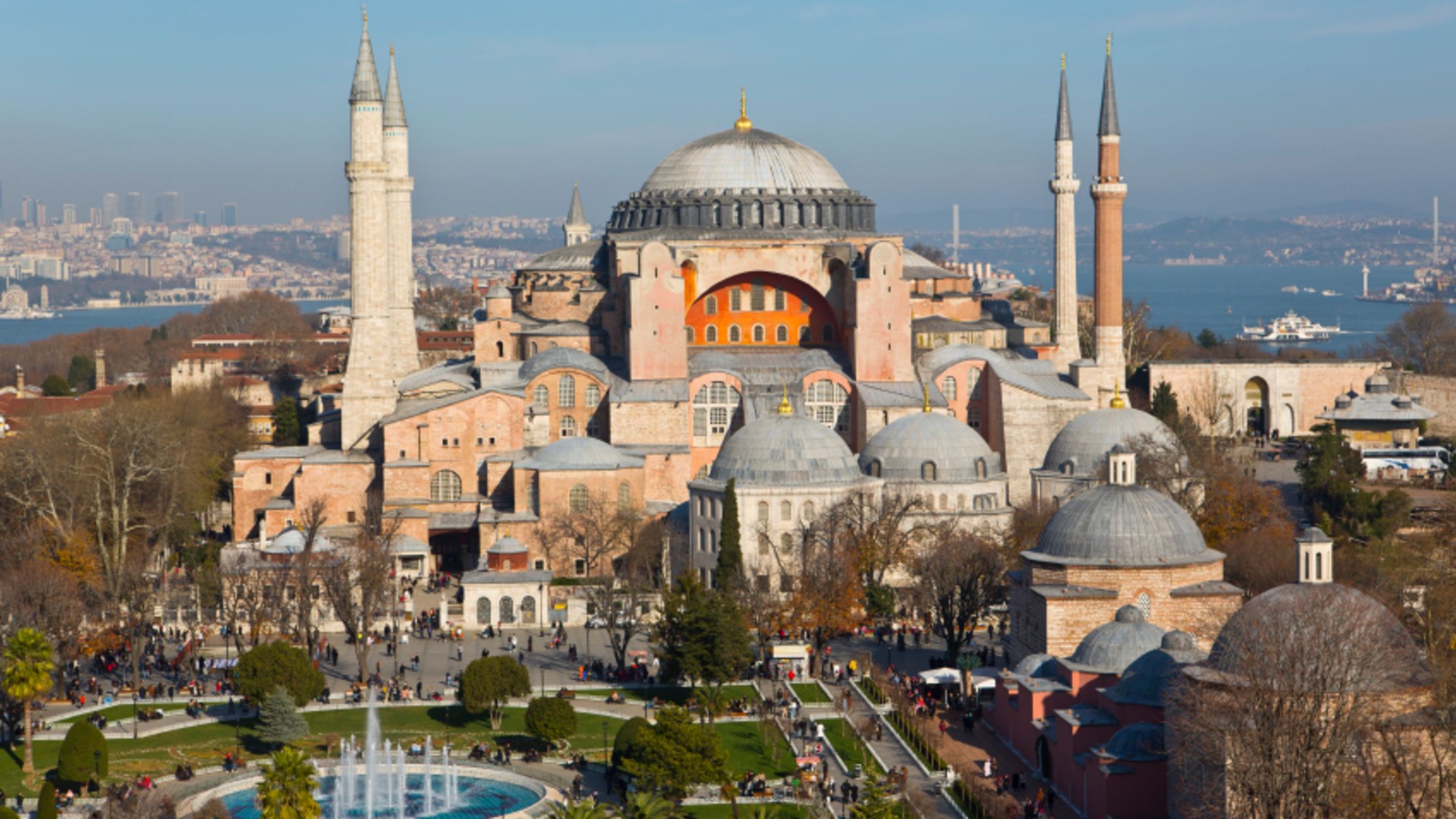
The world-famous Hagia Sophia museum in Istanbul - originally founded as a cathedral - has been turned back into a mosque.
Turkey's President Recep Tayyip Erdogan announced the decision after a court annulled the site's museum status.
Built 1,500 years ago as an Orthodox Christian cathedral, Hagia Sophia was converted into a mosque after the Ottoman conquest in 1453.
In 1934 it became a museum and is now a Unesco World Heritage site.
Defending the move, a Turkish official stressed that tourists could still visit the site after it once more became a mosque.
"May it be beneficial," Mr Erdogan said on Twitter, sharing a caption of the decision with his signature.Islamists in Turkey long called for it to be converted to a mosque but secular opposition members opposed the move. The proposal prompted criticism from religious and political leaders worldwide.
1. THE CHURCH WAS TWICE DESTROYED BY RIOTS.
First built in Constantinople in 360 CE and dedicated by the Roman Emperor Constantius II (son of Constantine, the founder of Constantinople), the initial, wood-constructed Hagia Sophia burned during a series of riots in 404 CE. In 415 CE, Emperor Theodosius II ordered the church rebuilt, but the Nika Revolt in 532 CE caused widespread death and destruction in the city, and the church was wiped out a second time.
2. THE FIRST GREAT BYZANTINE RULER ORDERED ITS RECONSTRUCTION.
Located in the Eastern Roman Empire region known as Byzantium, Constantinople was ruled for 38 years by the Emperor Justinian, starting in 527 CE. Five years after the Nika Revolt and the church’s destruction, Justinian inaugurated the newly rebuilt Hagia Sophia, the most important religious structure in his empire, on December 27, 537 CE.
3. THE CHURCH HAS GONE BY SEVERAL NAMES.
Initially called the Great Church (Megale Ekklesia in Greek, Magna Ecclesia in Latin) because of its immense size, the second incarnation of the church came to be known by the name Hagia Sophia around 430 CE. Its Greek meaning, "Holy Wisdom," remained after the church was rebuilt a century later. After conquest by the Ottomans it was called Ayasofya, and today it is the Ayasofya Müzesi.
4. THE ORIGINAL DOME WAS REPLACED AFTER AN EARTHQUAKE IN 558 CE.
Soaring 160 feet high, with a diameter of 131 feet, the grand feature of the Hagia Sophia was its large central dome. The dome and the church were designed by architects Anthemios of Tralles and Isidoros of Miletos, but unlike the dome of the Pantheon, which has never faltered, an earthquake in 558 CE caused the Hagia Sophia's dome to collapse. It was rebuilt to a height of 182 feet, and the walls were reinforced in 562 CE. The dome's weight is supported by a series of smaller domes, arcades, and four large arches.

5. ONE OF THE SEVEN ANCIENT WONDERS WAS USED IN THE CHURCH'S CONSTRUCTION.
To fortify (and beautify) the interior of the church, columns from the long-abandoned and destroyed Temple of Artemis in Ephesus were used for the Hagia Sophia. Additional building materials may also have come from ancient sites in Baalbeck and Pergamom.
6. IT'S A GREAT EXAMPLE OF BYZANTINE ART AND ARCHITECTURE.
Byzantium nurtured a centuries-long tradition of art, architecture, knowledge, theology, and literature in a style that fused Greek, Roman, and other Eastern traditions. Long after the decline of the Roman Empire from which it sprang, the Byzantine ruler Justinian spearheaded a series of urban reconstruction projects following the Nika Revolt and started with the Hagia Sophia. The new cathedral included the massive dome atop a rectangular basilica, abundant mosaics that covered nearly every surface, stone inlays, columns and pillars of marble, bronze doors, a marble door, a large cross at the dome’s apex, and a square area on the floor of the nave, paved in marble, called the omphalion, a place where emperors were crowned.
7. ICONOCLASM LED TO THE REMOVAL OF MANY PIECES OF ART
Meaning “image breaking” or “the smashing of images,” the period of iconoclasm (from about 726-787 CE and 815-843 CE) raged when the state banned the production or use of religious images, leaving the cross as the only acceptable icon. Many mosaics and paintings from the Hagia Sophia were destroyed, taken away, or plastered over.
8. A 90-YEAR-OLD, BLIND VENETIAN ONCE CAPTURED HAGIA SOPHIA.
During the Fourth Crusade in 1203 CE, Alexius IV managed to convince the Crusaders to help him take the throne of the Byzantine Empire in exchange for a series of promises and rewards. But just months later, he was murdered in a palace coup. The powerful Doge Enrico Dandolo, the chief magistrate of the Republic of Venice who was over 90 years old and blind, led the Latin Christians on a siege of Constantinople. The city and the church were sacked and desecrated, many golden mosaics were taken back to Italy, and Dandolo was buried at Hagia Sophia after his death in 1205 CE.

9. THE CHURCH BECAME A MOSQUE FOR 500 YEARS.
Centuries of sackings, conquests, sieges, raids, and crusades came to an end in 1453 CE with the fall of Constantinople at the hands of the Ottoman Empire, led first by Sultan Murad II and then his successor, Mehmed II. The city was renamed Istanbul, the church was looted for treasures, and Mehmed called for a restoration of the 900-year-old building and its conversion into a mosque.
10. A MULTITUDE OF ISLAMIC FEATURES WERE ADDED TO THE BUILDING.
To use the space as a mosque, the rulers ordered that a mihrab (prayer niche), minbar (pulpit), and a fountain for ablutions be added to the Hagia Sophia. A succession of minarets was added to the exterior, and a school, kitchen, library, mausoleums, and sultan’s lodge joined the site over the centuries.
11. THE SULTAN PROTECTED CHRISTIAN MOSAICS.
Instead of destroying the numerous frescoes and mosaics on the Hagia Sophia walls, Mehmed II ordered they be whitewashed in plaster and covered in Islamic designs and calligraphy. Many were later uncovered, documented, or restored by the Swiss-Italian architects Gaspare and Giuseppe Fossati.
12. BELIEVERS SAY THE 'WEEPING COLUMN' HAS HEALING POWERS.
Also called the "sweating column," the "wishing column," and the "perspiring column," the weeping column stands in the northwest portion of the church and is one of 107 columns in the building. The pillar is partly covered in bronze, with a hole in the middle, and it is damp to the touch. The alleged blessing of St. Gregory has led many to rub the column in search of divine healing.
13. THE FOUNDER OF MODERN TURKEY TURNED IT INTO A MUSEUM.
Former army officer Mustafa Kemal Atatürk founded modern Turkey and served as its first president from 1923 to 1938. In 1934, after banning many Islamic customs and Westernizing the country, Atatürk and the Turkish government secularized the former cathedral and mosque and converted it into a museum.
Well done fabulous
ReplyDeleteGreat history awesome
ReplyDeleteKeep it up.. Bro
ReplyDeleteIt will take a lot of time to compile all the fact about mosque and Istanbul history
Amazing history for mosque
ReplyDeleteThank brother
ReplyDeleteTurkey❤😊
ReplyDelete